Posts

Notes on running large lizards over forceplates
Image
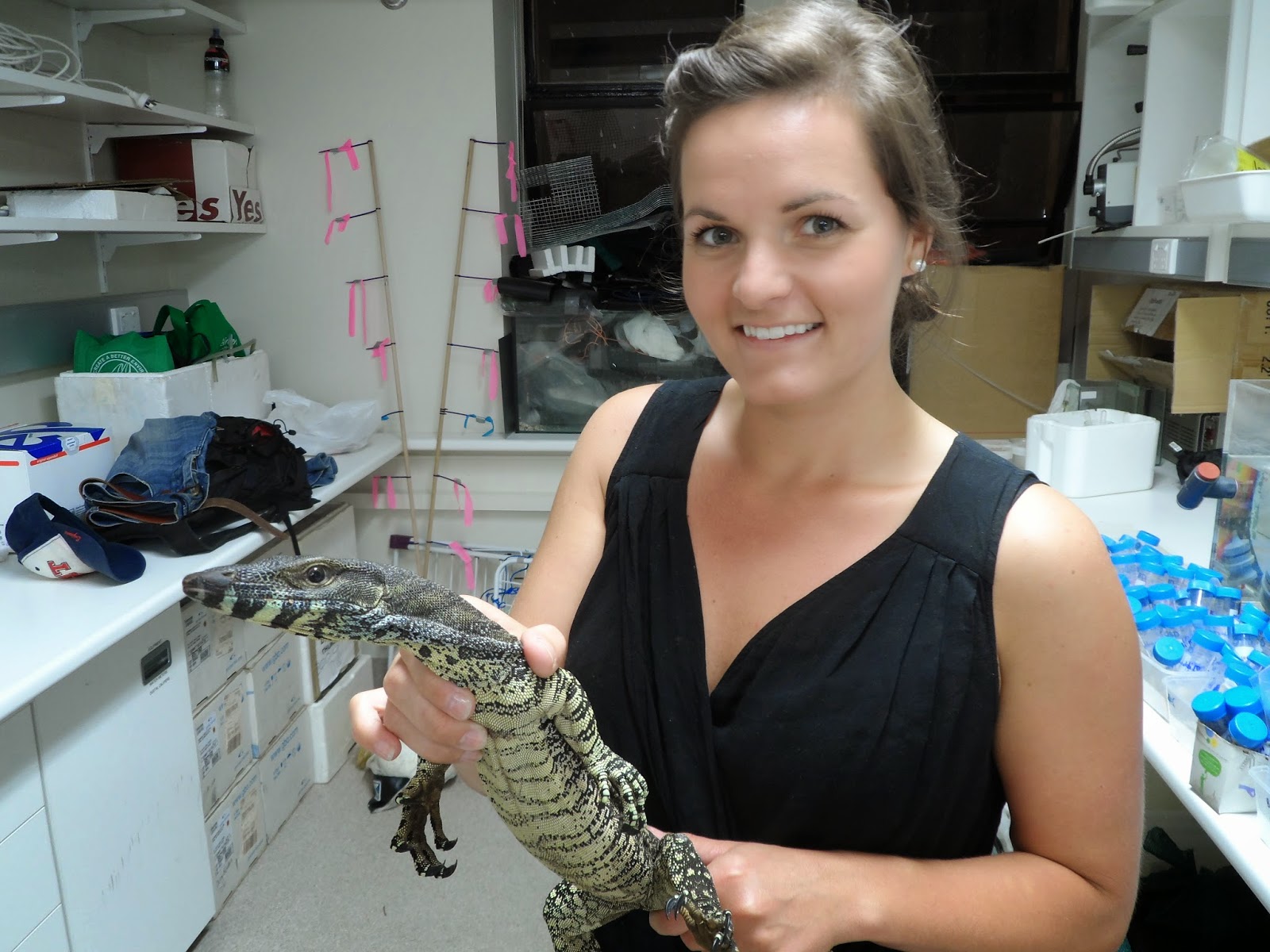
Taylor Dick, SFU (probably didn't expect to be holding a lizard that big anytime  during her stay). Anyone who has had the misfortune of stumbling upon this blog, and particularly those who have suffered through many of its posts might have noticed that one of the main themes is determining how muscle and bone strains change with body size and habitat among Australia’s giant lizards the Varanids (aka monitor lizards aka goannas aka large uncooperative lizards). Recently I had convinced Muscle expert Taylor Dick from SFU to come to Australia to study these questions with the eventual goal of building a musculoskeletal model of these lizards in the open-source biomechanics software OpenSim. She had already endured one trip out to the Australian desert in order to catch these beasts , but more was yet to come.   Example output of the force plate from a dragon lizard, A. gilberti Force plate design, shown here without a plate on the top. Photo probably tak...

How to catch a giant varanid lizard

Image
Recently at the SEB conference in Spain I convinced a muscle expert, Taylor Dick from Simon Fraser University in Canada, to come out to Australia to study muscle variation in Australian varanids. The purpose of this study was based upon a previous paper I had written “Lizard Tricks” of which I wrote a blog about here . But incase you missed it, basically I had found that differences in the Kinematics of the lizards hindlimb were not based upon changes in lizard size (as I had expected) but rather were related to changes in the lizards habitat. The Arboreal lizards (both big and small) had a crouched, sprawling posture, as if they were in a perpetual pushup, the terrestrial lizards (again both big and small) had a more upright posture. The reason for this difference was probably since arboreal lizards wanted to be close to the surface they were climbing on to avoid toppling over (and so had the crouched posture), while the terrestrial lizards wanted to improve stride length, and so ...

Making nice figures

Image
Figures are Important http://www.nature.com/nature/journal/vaop/ncurrent/full/nature12871.html Everyone seems to know that figures are the most important part of the paper, so why not do a little research into not only what makes a great figure, but also what makes a unique memorable figure.  Before you write a paper, or even start a project, its a good idea to know what figures you want to make. There are many different ways to display data, so have a look through them and decide which ones might be suitable for you.  These are some websites I like to take inspiration from  https://github.com/mbostock/d3/wiki/Gallery http://nicefigure.tumblr.com/ http://www.plosone.org/article/info:doi/10.1371/journal.pone.0007783 One important part of making figures is the use of color. Most journals will let you publish online color figures, but these must also be view-able in black and white (greyscale) format. It is therefore important to vary shading in your fig...

Lizard tricks: overcoming conflicting requirements of speed versus climbing ability by altering biomechanics of the lizard stride

Image
So recently I managed to publish a paper in the Journal of Experimental Biology about my dissertation work looking at the locomotion in Australia's biggest and baddest lizards the monitor lizards. I called it 'Lizard Tricks', not only cause I think they are doing something neat, but because I think what we see in these lizards would be a nice little engineering principal we could use in the design of robots or something else equally awesome. Ignoring for now that it took me over 6 years to figure this all out, I'd like to try and explain how I finally got to this point, and where we are with our understanding of locomotion in these beasts. All good studies should always start as simply as possible, and this is certainly where we began. In our earliest studies we compared the morphology of different species with their retreat site (Thompson et al. 2008). What we saw is that burrowing species tended to be different, from those that retreat into tree hollows, as sho...

Jumping beans in Slow motion

Image
Between 2010 and 2012 I worked at the Rowland institute at Harvard university. Most of my time was spent researching the muscular dynamics of frog muscle, by building robotic frogs, but every now and then we liked to goof off scientifically. That chance came the one day when the head of my workgroup, Chris Richards, brought in a mexican jumping bean. Being from Australia, I had not seen one of these before, and that is sad. Cause they are friken awesome! The bean itself is the seed of a shrub, the genus Sebastiania . Inside this bean is growing the larve of a little brown moth ( Cydia deshaisiana ). The moth makes a hollow inside the bean, as it eats the bean from within. But what makes it amazing is that it is able to thermoregulate by moving the bean from hotter places (such as in the sun) to cooler shadier places. It does this by 'jumping' - hence the name. The actual mechanism of how this tiny moth can get the whole bean to jump is unknown, and would probably require so...

Can the water dragon (Intellagama lesueurii) run on water?

Image
Can the water dragon (Intellagama  lesueurii) run on water?  I have long been impressed with the ability of the South American Basilisk lizard to run on water. There are plenty of videos of it on youtube, for example a short one here.  Its pretty amazing. Looking at this video alone shows as two important aspects of its locomotion, 1) it is able to lift the whole body out of the water, and 2) it is able to do so for quite long stretches (around 10-15m). This ability has been documented quite well by a series of papers by the group at Harvard University, particularly  Tonia Hsieh .  They have done some great work, including describing how smaller lizards are better able to support body weight than larger  lizards  , modelling 3D  forces  and recording 3D kinematics of the lizards  stride . Below is a gif showing some of the detailed kinematics of the lizard stride which i stole from George Lauders lab webpage.  ...